
Burlington City Directory Shelf
Burlington’s useful historical shelf is spread across the Miles Historical Room, the State Library, Internet Archive, and the Town’s archives. The State Library catalog confirms Burlington directory entries for 1919 and 1931-1932. It separately lists voting lists for 1946-48, 1948-49, 1978, 1980, and 1989. The catalog does not name a publisher for the Burlington directories, so a researcher should not assign a publisher label until a title page or a fuller catalog record proves it. That small restraint prevents a library finding from becoming a false citation.
| Collection | Years | Where Held | Access |
|---|---|---|---|
| Burlington directories | 1919; 1931-1932 | Massachusetts State Library holdings | Catalog and physical-library research; publisher not stated in the inspected PDF. |
| Burlington voting lists | 1946-48, 1948-49, 1978, 1980, 1989 | Massachusetts State Library | Physical or library research. |
| Burlington street lists | Selected digitized runs beginning in 1960 | Miles Historical Room and Internet Archive | Public and library access; check each scan for completeness. |
| Phone books, maps, yearbooks, annual reports | Exact local runs vary | Miles Historical Room | Reference collection, print, microfilm, and selected digitized material. |
| Burlington newspapers | Runs listed below | Burlington Public Library | Microfilm, print, and an in-library digital archive. |
For a person who appears only between the cataloged years, the library’s street lists, phone books, and newspaper files supply the bridge. A blank year does not prove a person left Burlington. It may only mark a gap between surviving volumes.
Burlington Directory Years at the Library
Burlington Public Library research services can connect a local-history question with Book-a-Librarian help, databases, and digitized local material. The Miles Historical Room is at 22 Sears Street, Burlington, and lists hours of Monday through Thursday 10-9, Friday 10-6, Saturday 10-2, and Sunday closed. It is open to researchers and the public, though calling the reference desk before a targeted visit is sensible. The room brings together materials about Burlington people, town annual reports, high-school yearbooks, street lists, maps, phone books, genealogy, pamphlets, photographs, microfilm, and books.
The Library’s research page shows the public starting point for those collections.
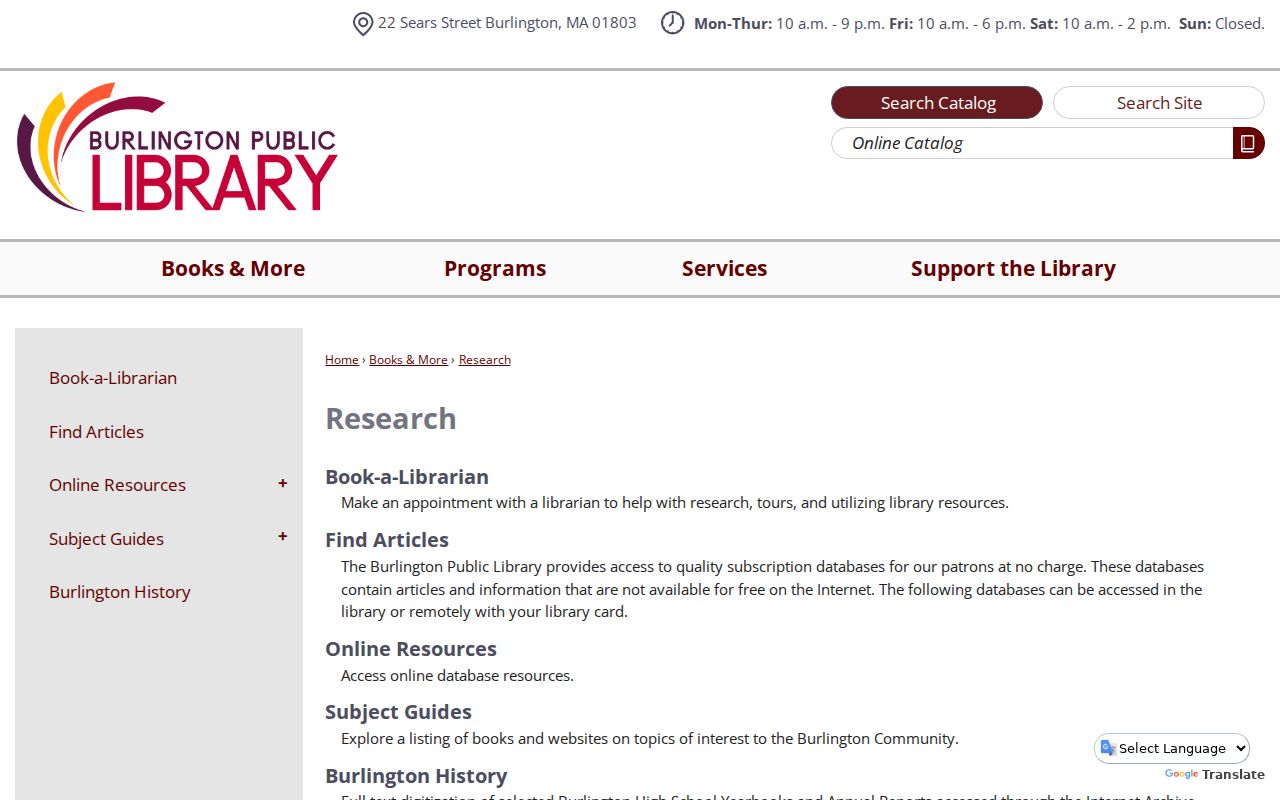
That local research route matters because an old name may be easier to confirm in a street list or yearbook than in a modern index.
Library cardholders may use subscription databases without charge in the library or remotely where a database permits it. The official research material did not confirm the current availability of any particular genealogy subscription, so call rather than assume a named database is available.
Burlington Historical Street Lists
Selected Burlington street lists have been digitized beginning in 1960. They are annual local resident-and-address enumerations, not automatically a current voter file. Search an actual scan by the year on its title, and inspect whether it is a full volume or a selected extract. Some volumes may have an alphabetical portion and a street-order portion. That form makes a street list especially useful for checking a known address after a name appears in another record.
Internet Archive’s Burlington street-list search provides the online lead for selected scans.
Use the volume’s own date and page order before extracting a household name, since the access route alone does not establish that a list is complete.
For a modern parcel or property-record sequence, use the address-centered evidence on the Burlington street directory rather than treating a historical list as a current occupancy record.
Reading a Burlington Directory Entry
The inspected State Library PDF and library collection page establish the collection type and year runs, not a text-opened Burlington entry. They do not prove that every line in a Burlington directory includes an occupation, spouse notation, ownership mark, telephone number, or a criss-cross section. Start by reading the title page and any key in the actual volume. Then record only the fields that appear on that page, including spelling, initials, suffixes, abbreviations, name order, and the address as printed.
| Verified at catalog level | Collection type and the Burlington year run. |
|---|---|
| Confirm in the actual volume | Whether the list is alphabetical, street ordered, or both. |
| Record exactly | Name spelling, initials, suffixes, address, and any visible abbreviation. |
| Do not presume | Occupation, spouse, ownership, renter, widow, telephone, or employer fields without seeing them. |
- Criss-cross directory
- A street-order section, if a volume includes one, arranged by address rather than solely by name.
- Householder index
- A name or household-oriented finding aid in a particular volume; confirm its form from the item itself.
- Abbreviation key
- A legend printed in a particular book that explains its shorthand. Photograph or note it before interpreting an entry.
These limits are useful. They keep a research note tied to the Burlington item in hand instead of to a directory pattern copied from another town.
Burlington Newspaper Trails
Newspapers often supply the event between two directory years. Burlington Public Library periodical holdings list Burlington News on microfilm for 1961-1992, Burlington Times-Union for 1963-1993, Burlington Union for 1993-2022, and Daily Times Chronicle for Burlington from 1982 to the present in print or microfilm. The Burlington Newspaper Online Archive is a growing Advantage Archives collection for in-library use. Search a name together with an address, school activity, civic notice, obituary, or development reference, then check the original issue rather than relying on a search snippet.
Newspaper material can explain a move, death, school connection, or building change. It does not make every printed address a current address.
Note: The newspaper runs overlap, so a gap in one title may be covered by another library holding.
Burlington Archive Records
The Burlington Town Archives covers municipal operations, departments, boards and committees, town history, development, vital documents, Town Meeting material, municipal personnel records, and secondary sources about people and organizations. Give the archivist a narrow description, such as a street, date range, annual report, or board subject. The Archives permits an anonymous request, provides one hour of reference or search time free, and charges $20 per hour after that. Call before visiting because the archivist may not be on site.
The Town Archives request page describes the access boundary and research-time policy.
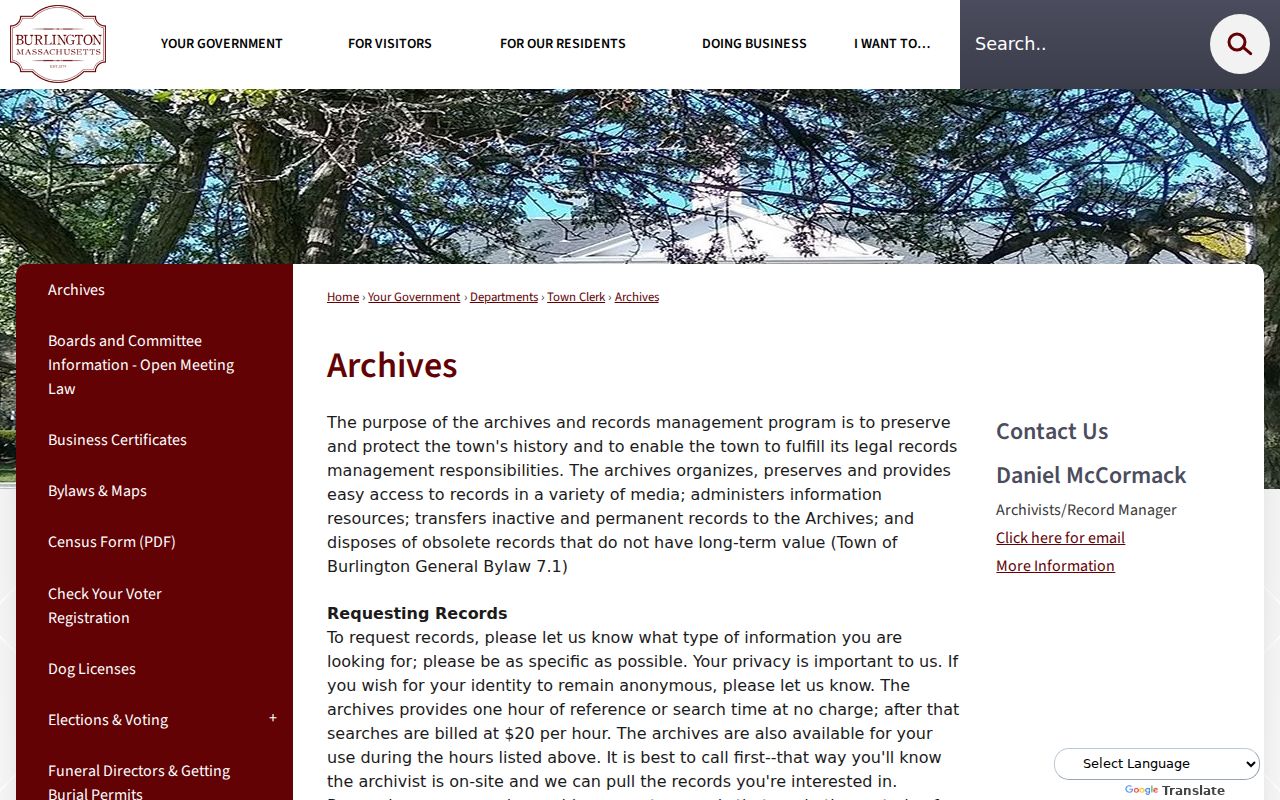
Town archival work can fill a gap left by a printed directory, particularly when a household is tied to a municipal event or local development record.
Before Burlington, Woburn and Second Parish
Burlington began as part of Woburn and Charlestown Village, became Woburn Second Parish in 1730, and became an independent town on February 28, 1799. Pre-1799 material may therefore be filed under Woburn rather than Burlington. The 1897 Sewall House fire also destroyed valuable historical data, according to the Historical Commission. A missing early family trace is not proof that a household was absent. It can reflect the older jurisdiction, a records loss, or the simple fact that a later kind of directory did not yet exist.
- 1730: Woburn Second Parish begins, an earlier jurisdiction label for local records.
- 1799: Burlington becomes an independent town, shifting the local filing context.
- 1897: The Sewall House fire destroys valuable historical data.
- 1919: The first Burlington directory year confirmed by the State Library holdings appears.
- 1931-1932: The State Library lists another verified Burlington directory run.
- 1960 forward: Selected Burlington street lists begin in the digitized collection.
Use State Archives and Woburn historical sources for the earlier period. For Burlington’s later local trail, pair library material with Town Archives and actual maps or deeds.
Tracing Burlington Directory Households
Trace one household across the real Burlington runs instead of expecting an unbroken annual sequence. Begin close to the family event, write down the form of the name and address, then work in both directions. Census releases provide a useful household check: the 1950 census is open, and earlier census schedules through 1950 can be compared under the 72-year release practice. Census geography is not a precise present-day address roll, so use maps, street lists, and deeds to reconcile it with a current street name.
- Choose a known name or address and a volume near the event being researched.
- Copy the spelling, initials, suffixes, address, and any visible household clue without expanding abbreviations.
- Move through the confirmed State Library holdings, selected 1960-forward street lists, phone books, and local newspapers.
- Pair a directory or list year with the 1930, 1940, or 1950 census when the household needs a wider check.
- Use a deed chain to separate an owner from an occupant, then use obituary, probate, cemetery staff, or vital-record channels for an endpoint.
Burlington’s rapid 1950s and 1960s growth introduced new streets and numbering. Verify an old address against a map or street list before treating it as the same property today.
Burlington Records Research Route
Use the Miles Historical Room for the local shelf and reference help. Use the State Library holdings for the verified 1919, 1931-1932, and voting-list catalog entries. Use Internet Archive for the selected digitized street lists and annual reports, and use Town Archives for municipal material that needs a request. Massachusetts genealogy guidance places historical vital records at the State Archives for 1841-1935 and RVRS records at 1936-present; the research room’s records are available in person rather than through a general online index. Earlier records may be local. Cemetery staff can check burial or lot facts, but no Burlington public interment-name database was located.
This mix of counters, library materials, archive requests, and digital scans is why a Burlington household trail often has several stops. Keep the source, year, page, and whether the item was a catalog entry, a scan, or a record image with every note. That lets the next volume confirm or correct an earlier lead.