
Burlington Previous Residents by Era
One address produces several different histories. Deeds follow title and ownership transfer. Street lists and directories may show a household or address entry. Census pages describe a household in an enumeration geography, not necessarily a modern parcel. Permits, maps, newspapers, probate, and vital records help test dates between those sources. The coverage table gives the right Burlington channel for each part of the backward trail and preserves the limits of each source.
| Historical source | Years available | Where it is held | What it can show |
|---|---|---|---|
| MassLandRecords index | Current live index; earliest web year not published | Middlesex South Registry online | Parties, deed or document type and date, town, book-page or document reference, and image. |
| Grantor indices | 1896-1973 | Online and Registry research | Grantor-side searching for an earlier transfer. |
| Unindexed property books | Book 1-1024; year span not stated | MassLandRecords mode or Registry | An earlier or unindexed property fallback. |
| Burlington street lists | Selected digitized runs beginning in 1960 | Miles Historical Room and Internet Archive | Address or resident-list evidence, depending on the actual volume. |
| State Library directories | 1919; 1931-1932 | State Library holdings | Historic Burlington directory entries; publisher and entry format were not identified in the inspected catalog. |
| Voting lists | 1946-48, 1948-49, 1978, 1980, 1989 | State Library | Historical voter or street-list layer. |
| Federal census | 1790-1950 public releases | NARA, FamilySearch, or library | Household, relationship, age, birthplace, and enumeration geography. |
Ownership does not prove residence. Likewise, a household entry does not prove title. Keeping those strands separate gives a much more reliable answer to who lived here before.
Fix a Burlington Address First
Write down the modern situs address exactly, then collect the current parcel or map-lot reference, owner clue, mailing address, and legal-description or plan information from Burlington GIS MapXpress. The situs address identifies the parcel, while the mailing address is where tax correspondence goes. They can differ. The Town of Burlington Assessors maintain ownership and property information, but the public property-card field labels and exact online history start are not published in the reviewed material.
Historical names need their own search pass. Burlington was Woburn Second Parish before becoming an independent town in 1799, and earlier records may use Woburn, Second Parish, Shawshin, or Shawsheen. A modern street number may also postdate a subdivision. Test street abbreviations, older road labels, legal-description terms, and map references instead of assuming an early source used the present address.
Work Back Through Burlington Deed Records
The parcel is the bridge to Middlesex County recorded land. The Middlesex South MassLandRecords portal has separate recorded-land, registered-land, plan, and unindexed-property modes. It can be searched by name, document, book, property, or recorded date, with party rows, party type, document type, town, and date controls. Search the present owner with Burlington selected, then switch to property, book, or document modes if a name query does not retrieve the purchase deed.
- Open the current purchase deed and note the grantee, grantor, recording date, book and page or document number, deed type, legal description, and any plan reference.
- Search the seller or grantor as a likely earlier grantee, using an earlier date range and the Burlington town filter.
- Confirm the same legal description, lot, plan, or parcel context before adding the earlier transfer to the chain.
- Repeat the grantor-to-earlier-grantee handoff until the ordinary online trail stops. Check registered-land modes as well as recorded land.
- Use Book 1-1024, Registry research, plans, local archives, and State Archives channels for an older or unindexed gap.
The Registry's official Middlesex South page describes free online document copies and announces the expanded grantor-index access.
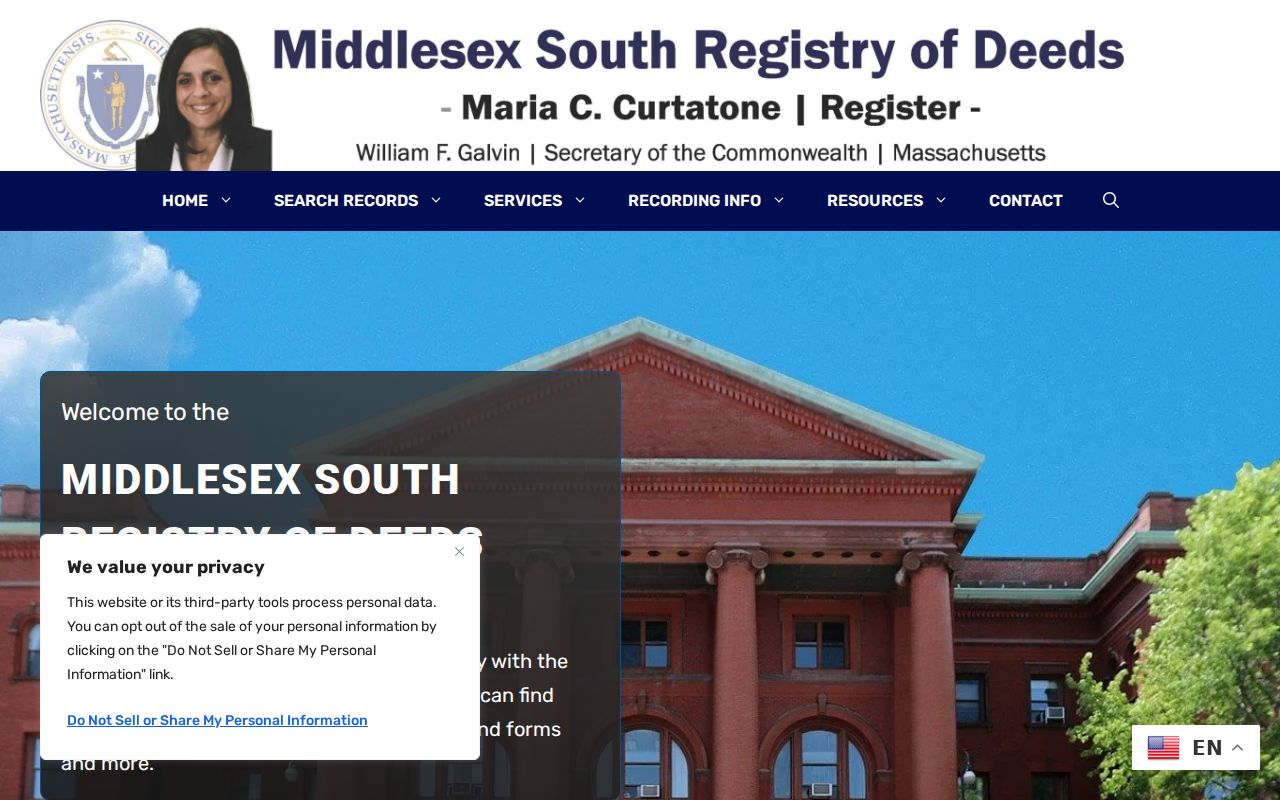
Use the recorded image to verify the chain. A party name can belong to a trustee, attorney, executor, mortgagee, or business, so a name match alone is not enough.
- Chain of title
- A sequence of recorded ownership transfers traced through deeds and their legal references.
- Grantor
- The party transferring an interest in a recorded instrument.
- Grantee
- The party receiving an interest. In a backward search, the prior grantor is commonly sought as an earlier grantee.
- Legal description
- The recorded lot, plan, metes-and-bounds, or other land description that ties documents to the same property more reliably than a street address.
Burlington Grantor Records Online
On October 21, 2025, Middlesex South announced that grantor indices from 1896 through 1973 were available online. That matters for previous residents research because a modern property search can fail when an early deed uses a lot or plan rather than a familiar street address. Search the later owner forward, then search the seller backward through the grantor and grantee trail, confirming book, page, document placement, town, and legal description at every turn.
The Registry has not published a single earliest year for its regular web index. Do not claim that the ordinary online database reaches every historic Burlington transfer. The explicit fallback is the Unindexed Property Search for Book 1-1024, followed by Registry staff or in-person research in Cambridge. Certified document copies can be requested in person, by mail, or email; the Registry lists $1 per certified document page and $5 per registered-land certificate, while regular online copies are free.
Note: A Registry warning about $118 deed-copy solicitations is a reason to start with the official free image and published Registry contact information.
Burlington Household Records and Census
After the deed trail identifies an era, turn to the local household layer. The Miles Historical Room holds street lists, phone books, maps, newspapers, yearbooks, town reports, photographs, genealogy resources, and microfilm. Burlington's verified State Library directory holdings are 1919 and 1931-1932. Its voting-list holdings are 1946-48, 1948-49, 1978, 1980, and 1989. Selected digitized street lists begin in 1960, but a reader should inspect each scan for the actual title, date, and whether it includes the desired street.
- Choose a directory, street-list, or voting-list year close to the deed transfer or a known family event.
- Search the name section and the street-order section when the specific volume has both, preserving initials, suffixes, and spelling.
- Pair the entry with the nearest released decennial census, including 1930, 1940, or 1950 where appropriate, rather than assuming a census line matches a modern parcel.
- Use the current or historic map and deed description to reconcile a road, lot, or numbering change.
- Use newspapers, probate, or a vital-record route to test why the household appears or disappears between two dates.
The Burlington city directory page identifies the collections themselves. Previous residents research uses them as dated evidence in a single-address trail, not as a substitute for the deed chain.
Burlington Street Lists After 1960
Selected Burlington street lists beginning in 1960 can be found through the Internet Archive search. They are valuable because Burlington's sharp postwar growth brought new roads and subdivisions. A list may preserve the address language used at the time, even when it differs from a modern parcel label. It remains historical local-list evidence, not a current voter file or a complete record of every person in a home.
Use the scan's own year and arrangement to decide whether it can place a household at an address. If the result is incomplete, call the library before relying on a selected online volume.
Burlington House-History Records Help
The Miles Historical Room at Burlington Public Library, 22 Sears Street, offers the most direct local support for household and address research. It is open to researchers and the public, with listed hours Monday through Thursday 10 to 9, Friday 10 to 6, Saturday 10 to 2, and Sunday closed. Call the reference desk before a focused visit. The library also offers Book-a-Librarian appointments for research help, tours, and its local resources.
The Burlington Town Archives holds municipal operations, development, Town Meeting, departmental, vital-document, and local-history material. A request may be anonymous. One reference or search hour is free, then additional research is billed at $20 per hour; call first because the archivist may not be on site.
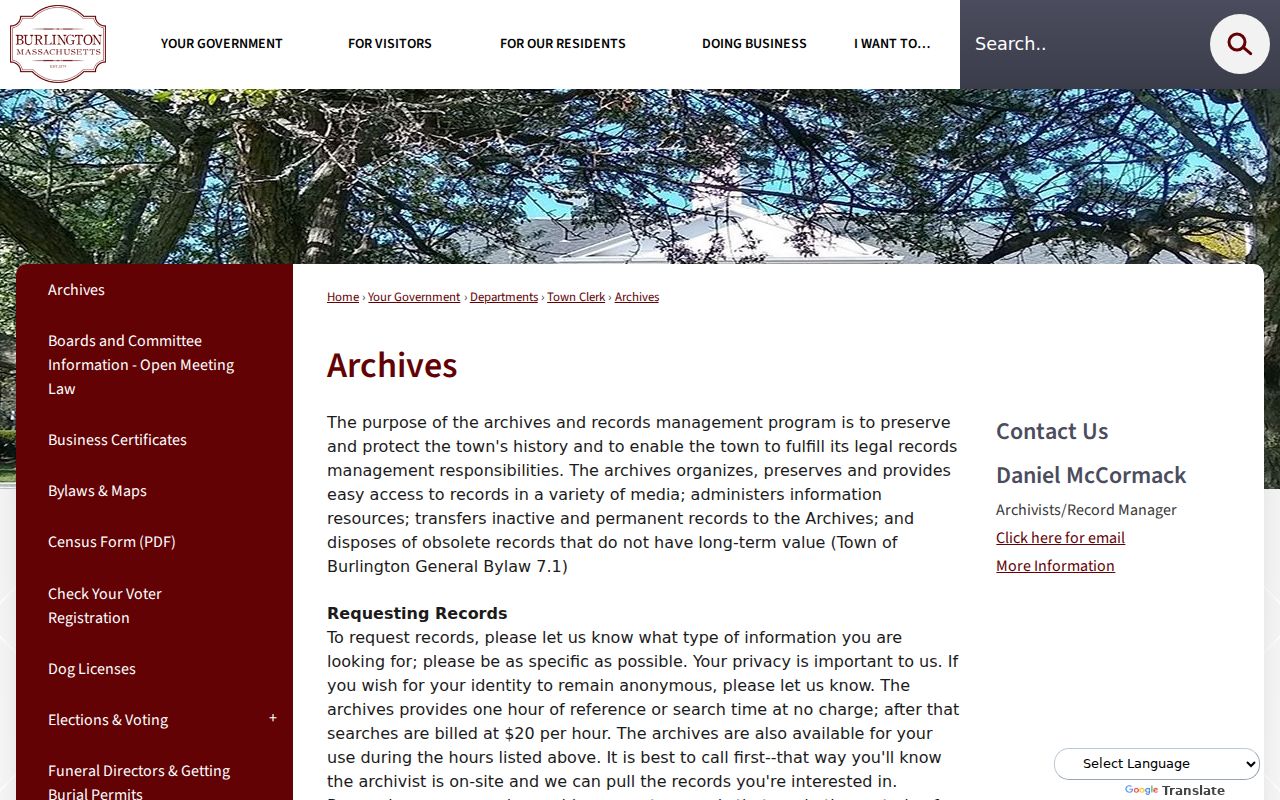
The archive is a useful fallback for dated municipal material. It is not evidence that every individual address file has survived or has been digitized.
Date Burlington Buildings Through Records
Maps, plans, and permits can explain why a former address seems to vanish. The ViewPoint/OpenGov portal searches an address or location first, then exposes record type, status, details, and files where available. Permits can date building, alteration, inspection, occupancy, or complaint activity. Burlington's 2024 report says historical building files and plans are being converted from microfiche to PDF, so an older record may be in transition rather than absent.
No specific Burlington, Massachusetts Sanborn map year was located in the official research. That absence matters. Do not assign an edition year to a house history without verifying a Library of Congress, State Library, or local-library item. Use published maps, plans, street lists, and the Registry's legal description instead.
Close a Burlington Household Records Trail
A disappearance from a Burlington address may be a sale, a move, a death, or a change in directory coverage. The Miles Historical Room has newspaper runs that can help: Burlington News from 1961-1992, Times-Union from 1963-1993, Burlington Union from 1993-2022, and Daily Times Chronicle from 1982 to the present. The Burlington Newspaper Online Archive is for in-library use. These are leads to evaluate alongside an official record, not automatic proof of a relationship or present location.
For an estate endpoint, MassCourts and Middlesex Probate and Family Court South-Woburn can provide public docket and estate pathways, subject to impoundment and image restrictions. Town cemetery staff can help with interment and lot records, but no public Burlington interment-name database was located. A death, probate, obituary, and deed transfer together can explain an ownership and household transition without identifying the current whereabouts of a living person.
Burlington Previous Residents Limits
Previous residents research is best suited to house history, family history, estate questions, and local history. It cannot provide a complete list of everyone who lived at a property. Deeds identify parties and ownership transfers, not every occupant. Street lists and directories reflect their particular publication year and format. Census geography can fall short of a modern parcel match. A protected address, sealed court file, or confidential voter record is a lawful boundary, not an invitation to find it elsewhere.
Lawful use. Use Burlington historical address records for legitimate personal and historical research. Never use a past address trail to stalk, harass, threaten, or track a living person.